Danger Zone?
From an economic standpoint, the stock market has entered a Danger Zone compared to where this bull has operated during its first couple years. But this Danger Zone is flashing Yellow, not Red!

Last Thursday, it was reported that U.S. real GDP growth moderated to only a 2.3% annualized pace in the fourth quarter. The trailing four-quarter pace of growth has moderated from 3.2% at the end of 2023 to 2.5% by the end of last year. The pace of economic growth matters for the stock market, and as real economic growth breaches 2.5%, it subjects investors to a potential danger zone.
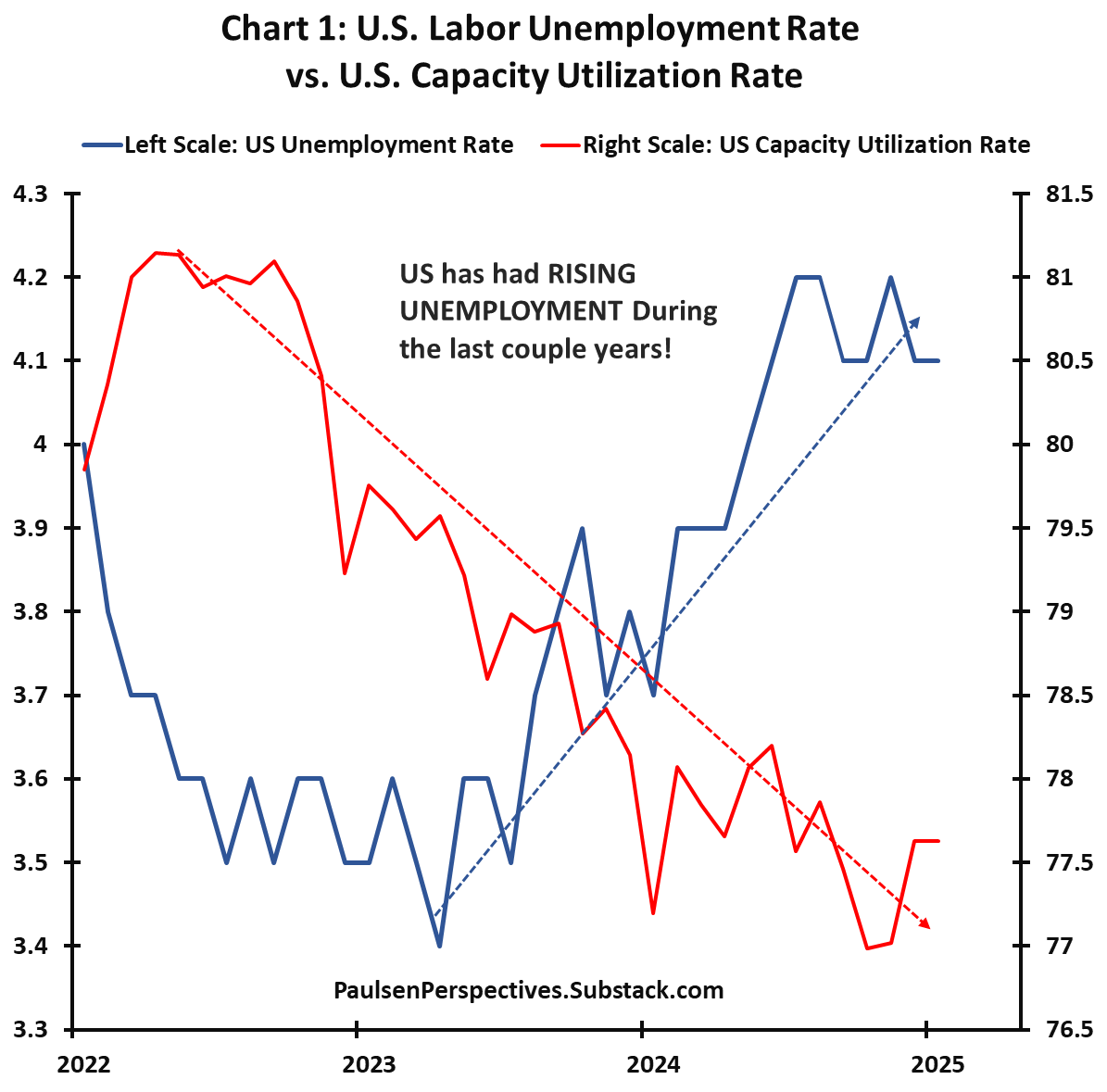
Declining below 2.5% real GDP growth does not necessarily imply bad times for the stock market. Indeed, bull markets usually begin when real GDP growth is weak if not often negative. However, what makes this slowdown a bit more cautionary is the fact the total unemployment rate in the economy has been rising for more than two years. This is not typically a problem when overall real GDP growth is robust, but real GDP growth below 2.5% has frequently proved challenging for stock investors when the unemployment is rising.
Chart 1 shows that despite fairly healthy real GDP growth, both labor and factory unemployment have been rising in the last couple years. The labor unemployment rate has risen from 3.4% in April 2023 to its bull market high of 4.2% just last November. At the same time the capacity utilization rate -- the inverse of which, 100 – capacity utilization rate, is a proxy for capital or factory unemployment – has declined from about 81% to 77%. So far, relatively healthy real GDP growth (i.e., growth in excess of 2.5%) has allowed the stock market to weather a slow but steady rise in both labor and capital unemployment. However, because of past contractionary economic policies, real GDP growth has slowed to 2.5% in the last year and seems poised to slow even further in 2025. Could rising economy-wide unemployment with relatively sluggish real GDP growth (i.e., less than 2.5%) bring turbulence to the stock market?